A gravel parking lot does not come with an exemption from the Americans with Disabilities Act. This is the single most common misconception among commercial property owners who have chosen unpaved surfaces to reduce upfront costs — and it is a misconception that generates real legal exposure.
Per the U.S. Access Board's guidance on ADA Standards (Section 201.3), the accessible parking requirements apply to all parking facilities, including temporary and unpaved lots such as gravel or grass surfaces. The surface type changes nothing about the obligation. What it does change is how that obligation must be met — because loose gravel itself cannot satisfy the ADA's firm, stable, slip-resistant surface requirement.
This post is for commercial property owners and facility managers operating or planning unpaved commercial lots. It covers exactly what the ADA and California's CBC Chapter 11B require for handicap parking spaces in gravel lots, what happens when those requirements are not met, and what the physical build-out of a compliant accessible space in an unpaved lot actually involves.
The Core Rule: Surface Requirements Apply Regardless of Lot Type
The ADA's surface standard for accessible parking spaces and access aisles is clear: the surface must be firm, stable, and slip-resistant per ADA Standards §302. This standard exists because loose, unstable, or uneven surfaces are functionally inaccessible to wheelchair users and others with mobility devices — a technically designated accessible space on loose gravel is not actually accessible.
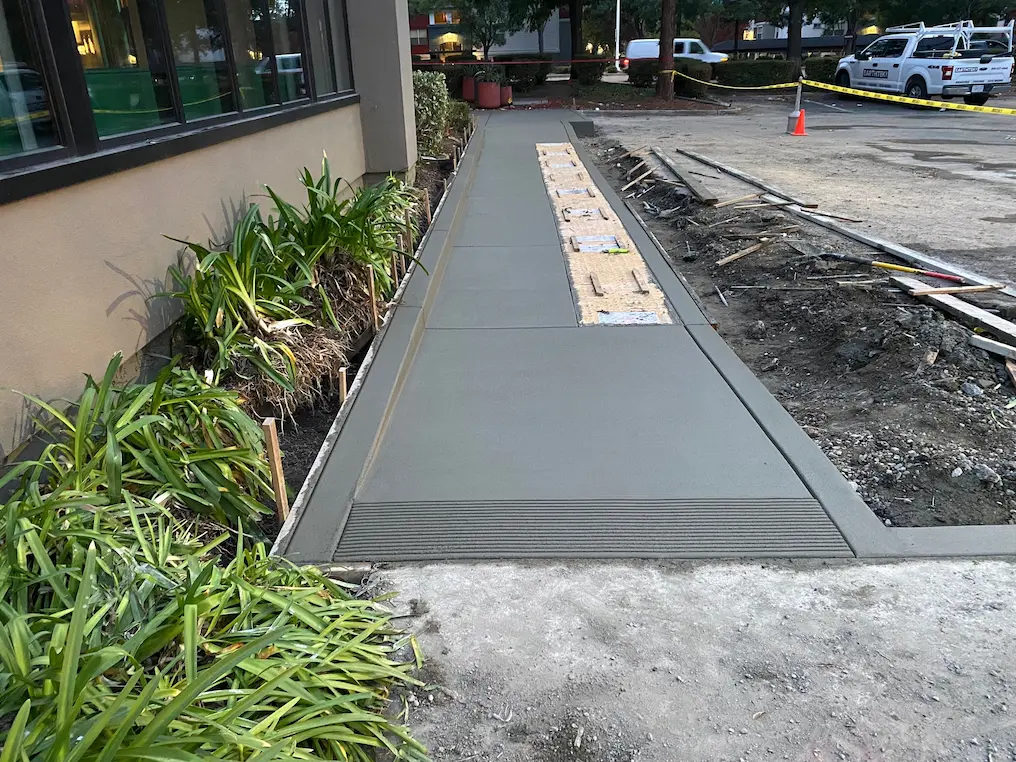
What this means in practice for a gravel commercial lot: the accessible parking spaces themselves, their access aisles, and the accessible route connecting them to the building entrance must all be on a paved surface. Asphalt or concrete pads installed within or adjacent to the gravel lot are the standard solution. The surrounding lot can remain gravel; the accessible infrastructure cannot.
California's CBC Chapter 11B applies the same standard and adds additional specificity on slope, signage, and dimensions that are stricter than federal ADA minimums. For commercial lots in California, CBC 11B is the operative standard — and any violation of CBC 11B is simultaneously a violation of the Unruh Civil Rights Act, which carries $4,000 in statutory damages per violation per visit with no injury required to file.
What a Compliant Handicap Parking Space Requires in an Unpaved Lot
The requirements for accessible spaces in an unpaved commercial lot are identical to those for a paved lot. The only difference is that the compliant surface must be provided as an installed feature within the gravel context rather than assumed from the lot surface itself. Here is the full standard:
| Requirement | Standard |
|---|---|
| Surface | Firm, stable, slip-resistant per ADA §302. Loose gravel does not comply. Paved pad (asphalt or concrete) required. |
| Stall width | 96 inches (8 ft) minimum for standard accessible spaces |
| Access aisle width | 60 inches (5 ft) minimum; 96 inches (8 ft) for van-accessible spaces |
| Van-accessible spaces | 1 of every 6 accessible spaces must be van-accessible with compliant surface and clearance |
| Slope | Maximum 1:48 (approx. 2%) in all directions on the stall and access aisle |
| Signage | ISA sign mounted minimum 60 inches above grade; "Van Accessible" on van spaces |
| Access aisle markings | "No Parking" painted inside aisle in contrasting color; blue hatching per California CBC 11B |
| Accessible route | Firm, stable, slip-resistant path from accessible spaces to building entrance — must not require travel through traffic lanes |
For a detailed breakdown of California's specific dimensional requirements, stall count formulas by lot size, and van-accessible space ratios, see the post on ADA parking stall requirements in California. Those requirements apply in full to unpaved lots.
How Many Accessible Spaces Are Required in a Commercial Gravel Lot?
The space count formula is the same as for any other commercial lot. One accessible space is required for lots with 1 to 25 total spaces. The count scales with lot size: four spaces for a 100-space lot, eight for a 400-space lot. At least one of every six accessible spaces must be van-accessible.
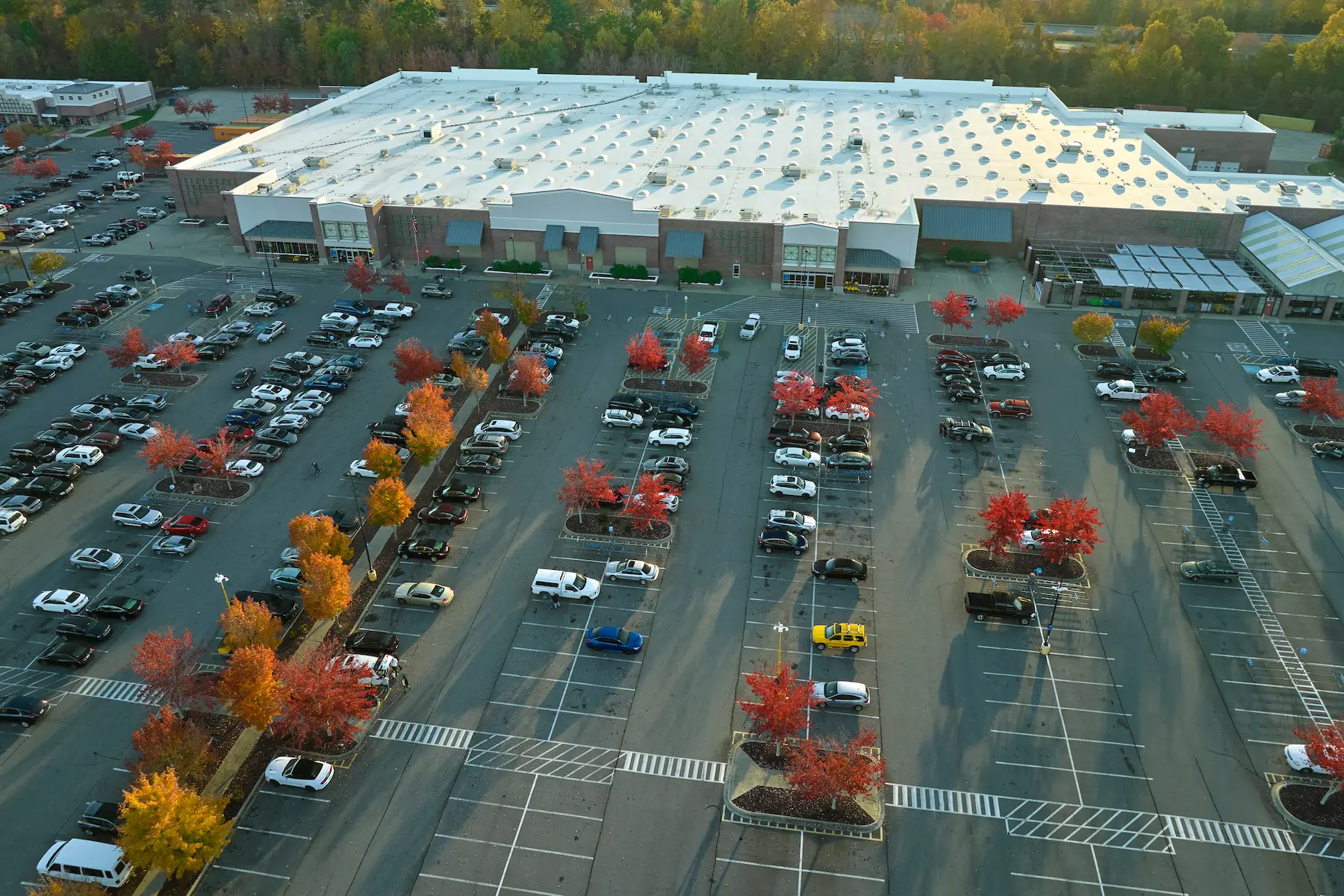
One nuance specific to properties with multiple parking areas: if a commercial site has both a gravel lot and a paved lot, the accessible space count is calculated separately for each facility, not combined across the site. A property with a 150-space paved lot and a 100-space gravel overflow lot needs accessible spaces in both lots — six in the paved lot and four in the gravel lot — not ten distributed at the property manager's discretion.
The accessible spaces in each lot must also be on the shortest accessible route to the building entrance served by that lot. Gravel lot accessible spaces cannot be located at the far edge of the property and redirected to the paved lot entrance — the accessible route must connect directly from the compliant space to the nearest accessible building entrance.
What the Physical Build-Out Looks Like
Installing ADA-compliant handicap parking spaces in a gravel lot requires constructing paved pads within the lot footprint. The typical approach:
- Excavate and grade the accessible space area to meet the 2% maximum slope requirement in all directions — this is the most common failure point and cannot be addressed with surface treatment alone
- Install a compacted aggregate base consistent with the surrounding gravel lot subbase
- Pour asphalt or concrete pads sized to accommodate the full stall width plus access aisle for each required accessible space
- Extend the paved surface along the accessible route from the space to the building entrance — this may require a paved path across a section of gravel lot
- Apply compliant striping, ISA symbols, and signage per CBC 11B specifications
For properties where multiple accessible spaces are required, clustering the paved pads in a contiguous section at the lot location closest to the building entrance is both the most cost-efficient layout and the most functionally compliant. Distributing individual paved pads across a large gravel lot increases both construction cost and route complexity.
EarthTek's ADA ramp and accessible space installation services include gravel lot pad construction, slope verification, striping, and signage — scoped as a single project rather than coordinated across multiple contractors.
The Liability Exposure for Non-Compliant Unpaved Lots in California
California's enforcement environment for ADA parking violations is driven almost entirely by private litigation. The California Commission on Disability Access received 4,319 ADA complaints in 2024, with parking violations ranking as the most commonly alleged construction-related violation. Serial plaintiff firms specifically target commercial parking because violations are visible from a vehicle and measurable with basic tools.
For an unpaved commercial lot with no compliant accessible spaces, the exposure is the same as for any other non-compliant lot: $4,000 per violation per visit under the Unruh Civil Rights Act, plus uncapped attorney fees, with no injury required to file. A lot with four deficiencies — no paved surface, wrong stall count, missing signage, non-compliant slope — generates $16,000 in minimum statutory exposure from a single plaintiff visit.
The property owner who avoids paving accessible spaces to save $5,000 to $10,000 in construction costs is taking on a liability exposure that can exceed that figure from a single complaint. And unlike the one-time cost of building compliant pads, the liability accumulates on every visit until the deficiency is corrected.
One meaningful protection: California Civil Code §55.52 reduces Unruh Act damages from $4,000 to $1,000 per violation and provides a 90-day litigation stay if a Certified Access Specialist (CASp) inspection was completed before the lawsuit was filed. For owners of unpaved commercial lots who have not yet been sued, commissioning a CASp inspection before any complaint is filed is the single most cost-effective protective step available. For more on how ADA enforcement works in California, see the post on ADA parking stall requirements and California liability.
When the Right Answer Is to Pave the Accessible Section
For commercial gravel lots where the required accessible space count is small — one or two spaces — the paved pad approach is straightforward and cost-efficient. For lots where the accessible space count is larger, or where the accessible route to the building entrance crosses a significant section of gravel, the cost of constructing isolated paved islands can approach the cost of paving a defined section of the lot outright.
Property managers should evaluate this comparison before scoping accessible space construction in a large gravel lot: the cost of paving the entry zone adjacent to the building entrance — the section that handles the most traffic and generates the most wear — versus the cost of constructing individual compliant pads throughout the lot. In many cases, partial paving of the high-use entry zone eliminates the accessible compliance issue, reduces gravel maintenance overhead in the highest-traffic area, and produces a more functional property layout.
EarthTek's commercial paving team provides assessments for gravel lot accessible space projects and partial paving conversions. If your lot has unresolved accessible space compliance, contact us for a site evaluation and scope recommendation.
Frequently Asked Questions
Do ADA handicap parking requirements apply to gravel parking lots?
Yes, without exception. The ADA Standards apply to all parking facilities, including temporary and unpaved lots such as gravel or grass surfaces, per ADA Standards Section 201.3. The surface type does not affect the obligation — it affects how the obligation must be met. Accessible spaces and their access aisles must still have firm, stable, slip-resistant surfaces, which means paved pads within the gravel lot are required.
Can loose gravel satisfy the ADA surface requirement for accessible parking?
No. Loose gravel is not firm or stable and does not meet the ADA's ground surface standard under §302. A gravel lot must include paved surfaces — asphalt or concrete — for all required accessible parking spaces, access aisles, and the accessible route connecting those spaces to the building entrance.
How many handicap parking spaces does a gravel commercial lot need?
The same count as any other commercial lot. One accessible space for 1 to 25 total spaces, scaling upward with lot size. At least one of every six accessible spaces must be van-accessible. If the property has multiple separate parking areas, each facility's accessible space count is calculated independently. All accessible spaces must be on the shortest route to the nearest accessible building entrance.
What is the slope requirement for an accessible parking space in a gravel lot?
The maximum slope is 1:48 (approximately 2%) in all directions, on both the parking stall surface and the access aisle. This applies to the paved pad within the gravel lot just as it does to any paved lot. Meeting this requirement in a gravel lot typically requires grading the area beneath the pad before installation — the 2% limit cannot be achieved through surface treatment after the fact.
What happens if a commercial gravel lot has no compliant accessible spaces in California?
The property is exposed to ADA complaints under both federal Title III and California's Unruh Civil Rights Act. California statutory damages are $4,000 per violation per visit, with no injury required and no pre-suit notice required. A lot with multiple deficiencies — no paved surface, incorrect count, missing signage, non-compliant slope — can generate thousands of dollars in statutory exposure from a single complaint. Having a CASp inspection completed before any complaint is filed is the only step that reduces that exposure under California Civil Code §55.52.